
Spotlight Interview: Welcoming Heather Seiders into her New Role as Interim Executive Director
Written by: Katherine Taylor, Communications Coordinator
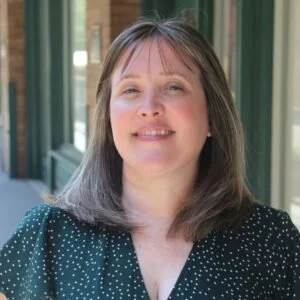
As Heather Seiders steps into her new role as Interim Executive Director, I had the pleasure of sitting down with her to learn more about the incredible knowledge and experience she brings to the table after working with Just Harvest for over 15 years. When I myself joined the Just Harvest team a year ago, I was introduced to Heather as Director of Engagement – where she was working to strengthen community partnerships, organize major fundraising events and growth, and lead key improvements in the operations of the organization.
Today, she joined me (with an incredibly adorable dog by her side) for a conversation to know a little bit more about her – as a writer, mother, advocate, leader – and much much more.
For those that don’t know you, tell us a little about yourself.
I’ve been with Just Harvest for over 15 years and have held different roles—administrative assistant, office manager, and Director of Engagement. I’ve been here since we were just six staff members, and I’ve helped build our website, led communications and outreach efforts, planned events and major fundraising campaigns and worked directly with clients.
I come to this work as a trained writer in creative nonfiction. That lens helps me ground our mission in real stories. When we connect those stories to the larger systems at play, that’s where real understanding and change can begin.
I’ve also always been drawn to the bigger picture, and to understand how systems are built, who they serve, and who they leave out. I see systems as choices we can remake. Policies and our systems should reflect what people need, and it’s our job to imagine something better.
Outside of work, I live in Forest Hills with my husband and two daughters. My daughters keep me humble and curious. They share my sense of justice and questioning—and remind me what’s worth fighting for.
If you could have dinner with any person, who would it be and why?
When I first interviewed at Just Harvest, I said Kurt Vonnegut. He had recently appeared on The Daily Show, and I was struck by how he still balanced sharp critique with humor and deep humanity, even at 80. His writing inspired me to fight for justice with humor and humanity.
Today, I’d choose to have dinner with my daughters 50 years from now. I really want to know what kind of world they are in – both to see what their lives are like, and to see the larger world that we built and if what we fought for paid off. I would like to see how our values now have shaped their future. I want to see it from their eyes.
What’s one movie, book, or podcast you would recommend?
Fear and Loathing: On the Campaign Trail 72’ written by Hunter S. Thompson isn’t your typical political reporting. It’s not objective, it’s the opposite. He really injects himself into the narrative and doesn’t hold back. He leans into his emotions and his subjectivity, and writes from the gut. The anger, humor, observations, and absurdity are all things that I believe are also really relevant right now. He exposes the machine and lays bare how campaigns are manipulated by the media and controlled by power structures – and cuts through with unfiltered honesty. His book doesn’t tell you how to build a coalition, or how to write a policy memo, but it reminds us to stay awake, stay skeptical, and find ways to laugh through chaos.
Can you tell us a bit about your background and what inspired you to join this organization?
I grew up in a working-class family. My mom worked at a non profit supporting people with disabilities, and I spent a lot of time there as a kid getting to know people, helping and learning what care really means. My dad worked in construction, and put his body on the line for work every day. Watching how hard they worked to (barely) make ends meet shaped me.
I came to Just Harvest as a young and idealistic writer looking for meaningful work. About a month in, I sat at Kristie’s wedding with Ken, Joni, their spouses, and a few other staff members. I realized then that the spirit of movements I had learned about for so long was still alive here. I thought to myself that night that these are my people. What keeps people at Just Harvest isn’t just the mission, it’s the shared belief that real change is possible, and that it has to be rooted in justice and community. That’s what brought me here, and what keeps me going.
What is your vision for the organization in the next couple of years?
We’re going to do what Just Harvest has always done: meet people’s immediate needs and push for structural change. But I also want us to call out the politics that prioritize profits over people. And I want us to lean into innovation and creativity.
That means building food access solutions that are actually shaped by our neighborhoods and the people living in them. It means using digital tools and technology to break down barriers and make it easier for folks to access the benefits they’re entitled to. And it means being bold enough to fight for what’s next. Policies like Guaranteed Income aren’t some far-off dream—they’re necessary.
Guaranteed income is the single biggest policy impact we can have – and we have the ability to shape it from ground up. There are a lot of problems with the social safety net as it exists now (a bureaucratic mess that is so complex, it can be nearly impossible for people to access and maintain the benefits they need). When people are in need of help, they need it now. There are likely a number of things in their life that they need, and money should be available and easy to access. We are not just adapting to policies, we are actually evolving.
We’ve spent decades helping people navigate broken systems. Our work now is to protect what people rely on today, while reimagining what we actually need. We don’t have time to wait for Washington. The urgency is here, and so are we. We will continue to build internally while modernizing how we operate and think about the delivery of our services.
Heather paused for a few moments, and added “I got sidetracked for a moment thinking about how important it is that my children who are walking through the room hear me talking about this.”
What are the biggest challenges you see in the fight against hunger today—and how do you hope to tackle them?
One of the biggest challenges is that we’ve made food political. The programs we work on like SNAP are under constant threat. And even when those programs exist, they’re often buried under red tape and designed in ways that make them hard to access. As benefits are being cut, grocery prices are up, and access to fresh food depends way too much on where you live. So people are stuck.
What we’re trying to do is not just fill gaps, but change the systems causing them. That means standing with communities to fight for better policies and build better ways for people to actually get what they need.
What role do partnerships and collaboration play in your leadership philosophy?
These are two fundamentals for me. Across movements, sectors, and communities – partnerships and collaboration are everything. As we have discussed, it is an incredibly divisive time right now, and partnerships rooted in trust and a shared purpose are so incredibly important. Not only does the political environment (and within it, cruel policies) make this a critical time, but there is also a division between those that are driven to protect their own gain and those that prioritize people over profit.
What is one initiative or project that you are looking forward to working on?
Oh, there are a few, but I keep coming back to Guaranteed Income. It’s long-term work, and it’s not going to be easy, but it’s the most powerful policy we can be push for right now. I mean, we already know it works. And in this political moment, where even accessing basic programs is getting harder and harder, that kind of bold policy feels necessary.
And alongside that, I’ve been thinking a lot about technology. Technology, especially AI, is moving fast, and if we’re not intentional, it could deepen economic inequality on a scale we’ve never seen. Guaranteed income is part of that because it’s a way to make sure people still have what they need even as the economy changes.
How can staff, volunteers, and supporters best support you in your new role?
Ask hard questions, share ideas, stay engaged, and believe that change is still possible. I am here to listen, lead with care, and to keep this mission moving forward.
What should folks know right now about the food justice system and how they can get involved to drive forward needed change?
The food system is broken, and it was built that way. It’s going to take more than good intentions to fix it. It’s going to take collective pressure, smart policy making, and clear public engagement. Every action counts – whether it’s calling legislators, volunteering, or making sure people know about SNAP and the resources available at Just Harvest. We need to not lose sight of the big picture: people. Right now, it feels like everything is against us in that fight.
Lastly, what do you like to do outside of work—any fun facts or personal passions you’d like to share?
I love being outside and getting my hands in the dirt, and I’ve gotten into chaos gardening lately. I also enjoy anything creative or DIY and experimenting in the kitchen (you won’t eat the same dish twice in my house). I spend most of my time with my kids and family—raising two fierce, independent girls is a huge part of who I am right now.
Something else that’s really important to me is the work I’ve done outside of Just Harvest around AI and public benefits. I spent a year leading a team at CMU’s Human-Computer Interaction Institute, designing a prototype and policy blueprint for the ethical use of AI in the public sector. That experience changed how I think about the responsibility of building systems that work for people. And it taught me about disruption. The healthy kind.
