

Research Reports
Publications
Barriers to Benefits
Barriers to Benefits: The New State of SNAP Access in Pennsylvania explores various barriers to SNAP such as: challenges receiving paperwork on time, difficulty communicating with the department, and issues navigating the program’s requirements. The event centered the experience of SNAP recipients as we called for improvements to state policies and practices..
The report covers the results of surveys and interviews with SNAP recipients conducted by Bill Emerson National Hunger Fellow Tylah Harrison.
On December 5th, 2024, Just Harvest presented our report, Barriers to Benefits: The New State of SNAP Access in Pennsylvania to PA Secretary of Human Services Dr. Val Arkoosh. Just Harvest was joined by community partners including MariSol Little, Associate Director at University of Pittsburgh’s Care and Resource Support Office (CRS), Aubrey Plesh, the Executive Director for Team PSBG, and Ms. Gwen, a survey participant – to share their experiences and insights on barriers to SNAP.
“People think food is a luxury – it’s not. It’s a necessity. It’s a human right.” – Ms. Gwen
View our one-pagers on focus areas explored in the report.
A Seat at the Table: Engaging Communities in Defining Racially-Equitable Food Access Solutions
For a long time, BIPOC community leaders have been excluded from decisions about their own communities. When they have been included they are often tokenized or uncompensated. This report recognizes that lived experience is a form of expertise, and shares steps for valuing, incorporating, and uplifting that expertise by way of co-creation.
This report aims to provide a framework for working with community partners and members with lived experience to design racially-equitable, sustainable, and community-based food access solutions.
No Child Should Live in Deep Poverty
The Meet the Need Coalition is a group of current and former TANF participants and advocacy organizations in Pennsylvania. We are working to improve the TANF program and increase the TANF grant amount. The effort is spearheaded by Community Legal Services, Pennsylvania Health Access Network, Black Women’s Policy Agenda, and Just Harvest.
This report shares survey responses, background on the TANF program, and suggestions for improvement so that
TANF can truly meet the needs of Pennsylvanians living in poverty.
The Pittsburgh School Food Environment: Strength and Opportunities in the Pittsburgh Public School District
Authored by the Harvard Food Law and Policy Clinic, this report is the result of the Pittsburgh Food Policy Council’s (PFPC) year-long partnership with Harvard and Pittsburgh Public Schools to better understand the challenges faced by schools in our city, to identify best food policies and practices in Pittsburgh and comparable cities, and to highlight recommendations for future work.
Just Harvest is a member of the PFPC and helped to lead this effort.
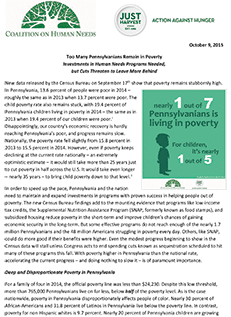
Too Many Pennsylvanians Remain in Poverty
New data released by the Census Bureau on September 17th show that poverty remains stubbornly high. In Pennsylvania, 13.6 percent of people were poor in 2014 – roughly the same as in 2013 when 13.7 percent were poor. The child poverty rate also remains stuck, with 19.4 percent of Pennsylvania children living in poverty in 2014 – the same as in 2013 when 19.4 percent of our children were poor. Disappointingly, our country’s economic recovery is hardly reaching Pennsylvania’s poor, and progress remains slow.
Nationally, the poverty rate fell slightly from 15.8 percent in 2013 to 15.5 percent in 2014. However, even if poverty keeps declining at the current rate nationally – an extremely optimistic estimate – it would still take more than 25 years just to cut poverty in half across the U.S. It would take even longer – nearly 35 years – to bring child poverty down to that level.
Barriers to Benefits
Recipients of Supplemental Nutrition Assistance Program (SNAP) benefits (“food stamps”) frequently call Just Harvest for assistance with overcoming obstacles in obtaining and maintaining benefits through the Department of Public Welfare (DPW). To deepen our understanding of the frequency of the problems applicants face, food stamp consumers were surveyed about their experiences applying for and receiving those benefits, and test calls were made to the publicly available phone numbers of DPW’s Customer Help Lines and County Assistance Offices located within Allegheny County.
The results of these surveys and test calls illustrate that the department is failing to provide consumers with basic service at a level that is necessary for obtaining and maintaining benefits.

A Menu for Food Justice: Strategies for Improving Access to Healthy Foods in Allegheny County
Written for Just Harvest by Zachary Murray during his time with us as an Emerson Fellow of the Congressional Hunger Center in 2012-13, the report is a comprehensive assessment of the food desert status of Pittsburgh and Allegheny County’s most vulnerable communities.
Hunger in Children in the United States: Potential Behavioral and Emotional Correlates
Authors: Ronald E. Kleinman, J. Michael Murphy, Michelle Little, Maria Pagano, Cheryl A. Wehler, Kenneth Regal and Michael S. Jellinek, Pediatrics 1998