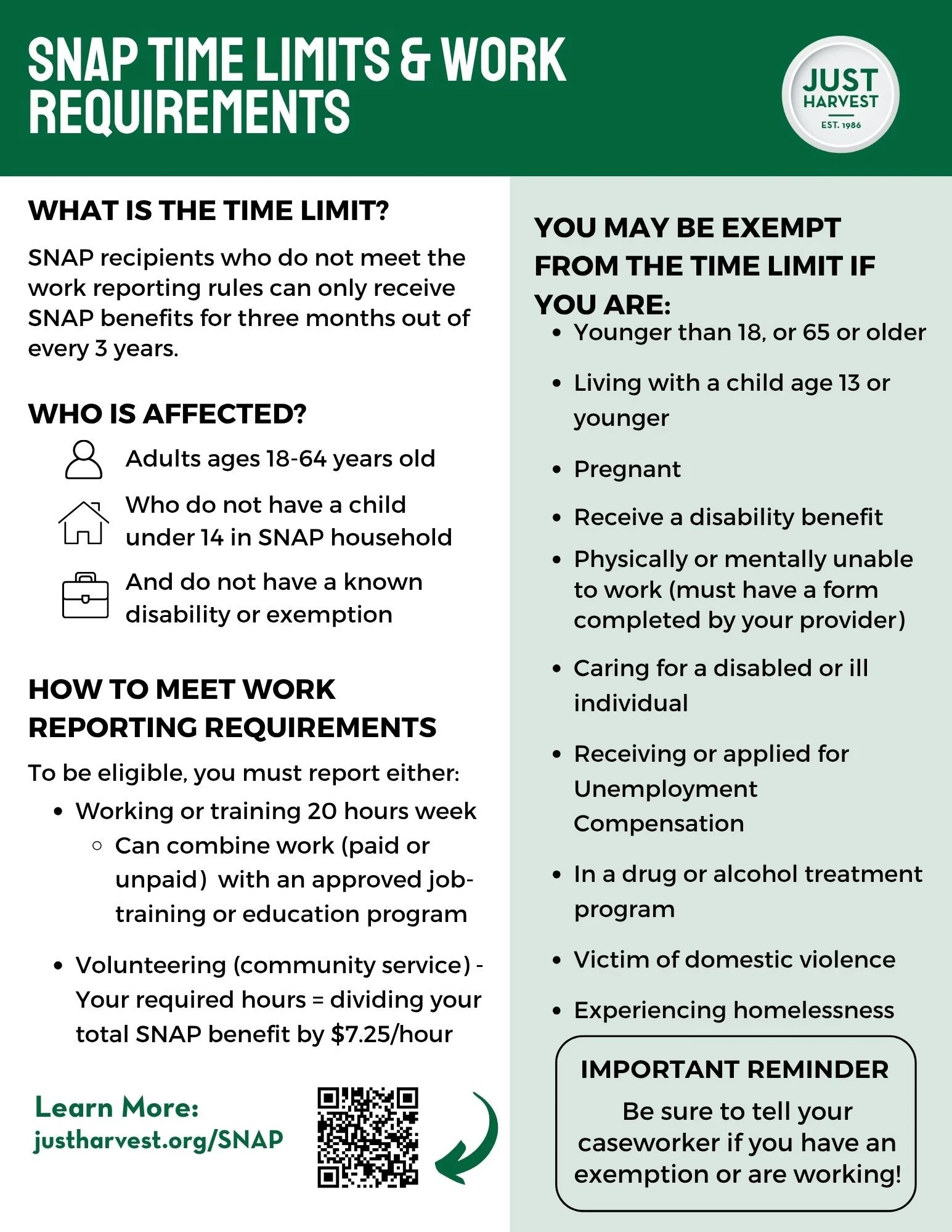
SNAP Time Limits and Work Requirements: What You Need to Know
Federal law limits the amount of time some adults without younger children or a documented disability can receive SNAP benefits.
The “One, Big Beautiful Bill” passed by President Trump will expand who these time limits apply to. Starting in the fall of 2025, time limits will newly apply to many older adults ages 55-64 and parents whose children are older than 13.
Use this screener from Community Legal Services of Philadelphia to help identify whether you should be exempt from the SNAP work requirements.

Three Month Time Limit
If you are between the ages of 18-64, do not have a child age 13 or younger in your household, and do not have a documented exemption, you are considered an Pennsylvanian with Employment or Engagement Requirement (PEER).
PEERs who are not meeting federally defined work reporting requirements will only be eligible for SNAP for 3 months in a 3-year period.
What are the exemptions?
Being exempt not only protects you from losing your benefits in three months, it also means you are not subjected to additional reporting. You can review the list below, or use this screening tool provided by PA DHS.
If you have an exemption, you should report this to your County Assistance Office or call the customer service center at 1-877-395-8930 (in Philadelphia, call 215-560-7226) as soon as possible.
-
These requirements apply to any adult in the household after they turn 18 until their 65th birthday.
-
You have a child under 14 in your SNAP household, this does not have to be your own child.
You provide care for someone under the age of 6 or who is ill or incapacitated. This does not have to be someone you live with, but DHS may ask for a note from the doctor of the person you prove care for.
-
You receive SSI, SSDI, or VA pension with 10% disability or more
You receive worker’s comp or short term disability - DHS may require award letter
You have a hard time working or can’t work at least 20 hours per week due to short or long term health reasons (mental or physical)** requires verification, you can use this form.
You are Pregnant
You are in a drug or alcohol treatment program
-
You earn $217.50 or more per week, or $870 per month
You work 30 or more hours per week.
You have applied for or getting unemployment benefits
You expect to return to work within 60 days (DHS will require you to renew your benefits within 3 months if this exemption is claimed).
-
You are couch surfing or staying somewhere temporarily, for less than than 90 days in one specific residence
You are staying in a halfway house
You are staying in a shelter
You are homeless
You are facing eviction in the next 14 days
-
If working would put you or your household at risk, or prolong recovery from domestic violence
-
You attend school or a training program at least half-time. While exempt from these rules, you must be meeting the student rules.
If I do not have an exemption to report, how can I make sure to keep my SNAP benefits?
You can maintain benefits by participating in employment or other engagement activities for 80 hours per month, or by completing enough community service hours to “work” for your benefits.
-
Work includes:
Hourly paid work
Work from self-employment, verifying hours spent working
Work in exchange for non-monetary payment, such as in exchange for rent
Unpaid work for an organization or person (such as providing childcare to a family member) internships, and apprenticeships
Unpaid internships and apprenticeships
If you are working, but are working less than 80 hours per month, you can combine work with work and education programs.
-
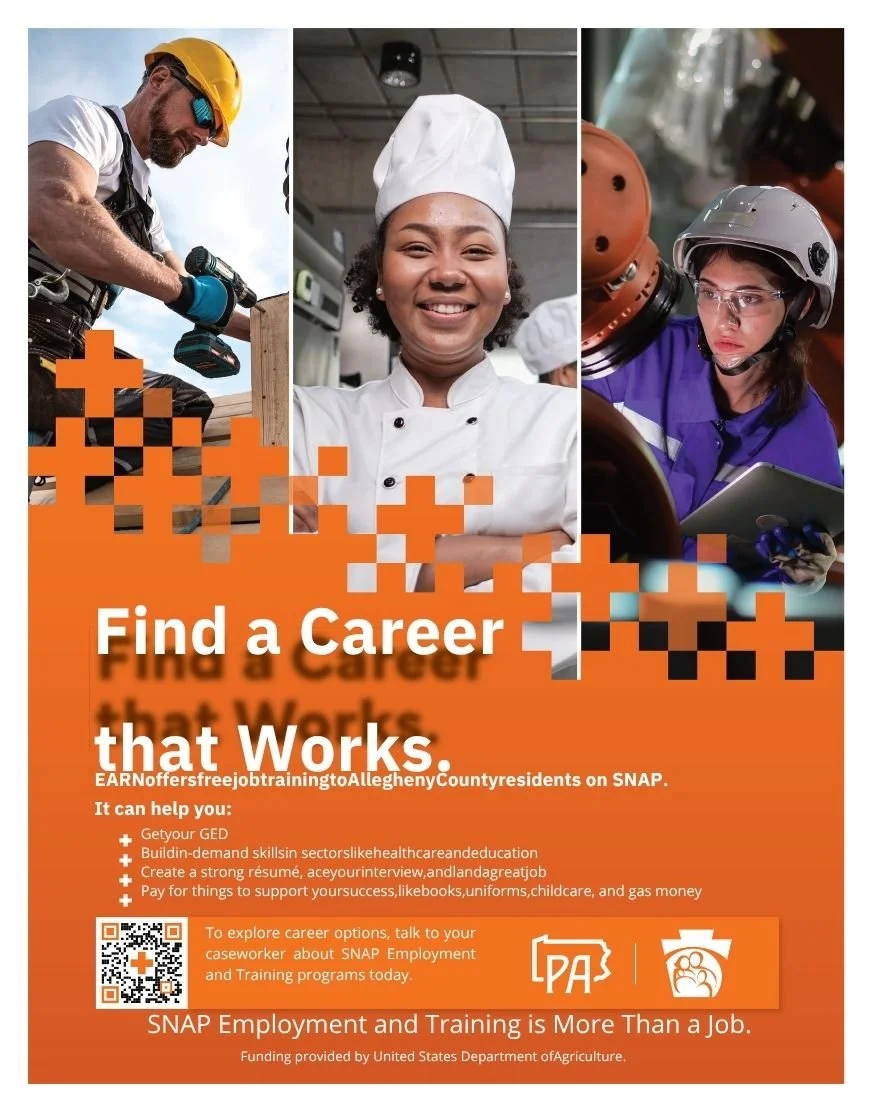
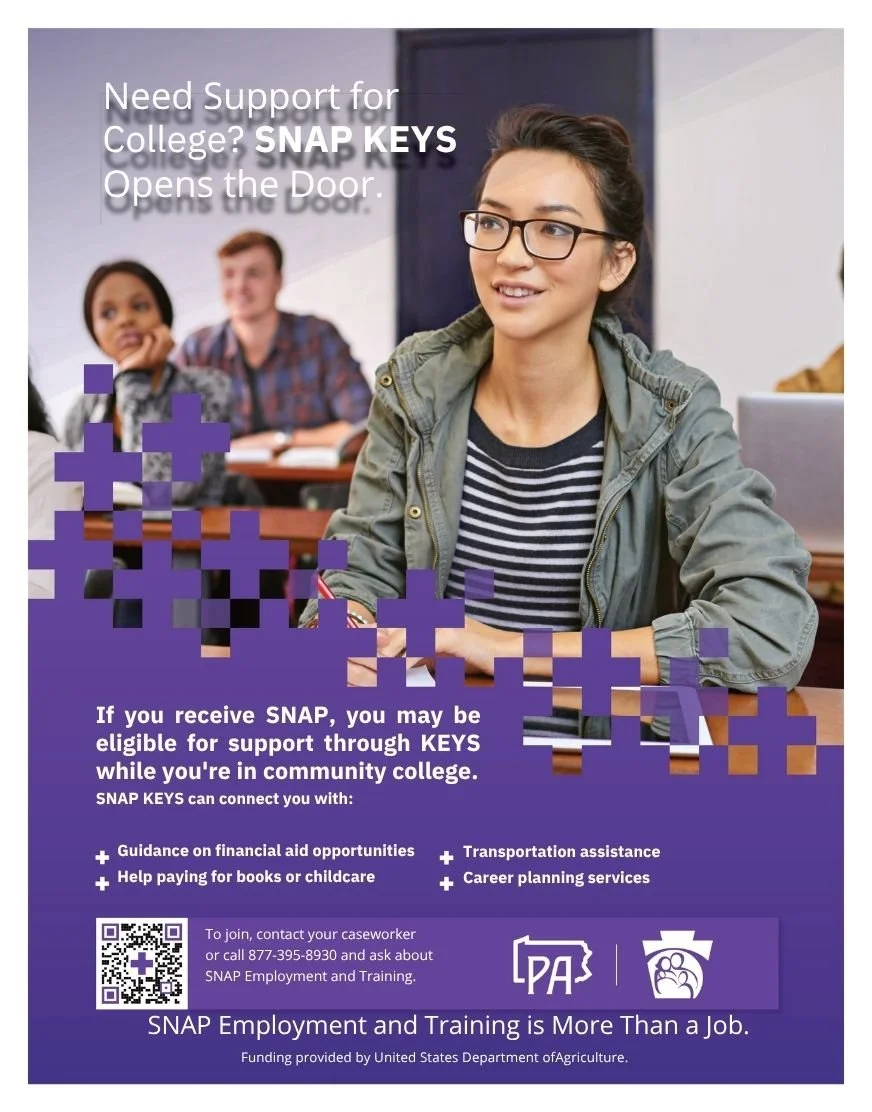
All SNAP recipients can volunteer to participate in employment and training programs that can help you get back to school, gain a skill, or find employment. You can get support with paying for child care, transportation costs, supplies, hygiene items and more while you participate. Nearby employment and training programs include:
KEYS - Keystone Education Yields Success (KEYS) provides community college students with support in navigating financial aid, careers, and support with costs like books, child care, transportation, hygiene items, and more.
SNAP Job Experience & Training Services (JETS): Learn a specific trade or skill. All programs are free, and some provide stipends or pay while you train. Current programs include Bidwell Training Center, Center for Employment Opportunities, Community Kitchen Pittsburgh, Landforce, and Trade Institute of Pittsburgh
EARN programs: can help you get your GED, learn skills, and improve your resume and interview skills.
Not in Allegheny County? Visit the DHS webpage about SNAP Employment & Training or talk to your local County Assistance office about programs in your area.
-
You can complete community service hours to maintain your benefits.
The required volunteer hours vary by adult, but are figured out by dividing your total household SNAP benefit by the state minimum wage of $7.25/hour. For example, if you are receiving the maximum amount of food stamps — $292 for a single person — you will need to serve an average of 40 hours per month ($292 / $7.25 = 40 hours per month or about 10 hours per week.
This is a monitored activity, if you want to do community service to meet your hours, talk to your DHS caseworker.

FAQs
-
If you are the only person in the SNAP household, DHS will mail you notice that your benefits will end. You may reapply once you are able to show an exemption or become able to work or participate in an approved program.
If you are in the household with other adults or teenage children, DHS will mail you a notice about you being removed from the SNAP household and benefits being reduced. By reporting an exemption, reporting work, or participating in an approved activity, you can be added back into the SNAP household.
You can reapply when the current three year clock resets, January 1, 2027.
If you use up your three months, and then are able to show an exemption or employment to regain SNAP, but then lose your employment or exemption within the three years, you may qualify for an additional 3 months where you are not meeting the requirement.
For example, you received SNAP for three months, lost your benefits, found a job and worked for 6 months, but are now unemployed – you might be able to get SNAP for another 3 months without meeting the requirement.
-
If you lose your exemption at any point, the three-month time limit will apply again starting at your next SNAP renewal.
If you think one of the exemptions might describe you, call the Statewide Customer Service Center at 1-877-395-8930 (in Philadelphia, call 215-560-7226) as soon as possible.
-
You are required to report if your work hours drop below 80 hours per month within 10 days of the month ending. If you were unable to complete your hours due to illness, an emergency, temporary transportation problems, or a hostile work environment you can claim “good cause” for not being able to meet your hours.
Otherwise, your caseworker will review you meeting your hours requirement every six months with your Semi-Annual Report.
-
Yes. The Department of Human Services (DHS) can give you Special Allowances (SPAL’s) to help you meet the requirement. SPAL’s include things like: money for transportation (bus passes or gas cards), clothing, hygiene items, and tools needed for education, training, or community service. These allowances must be requested and approved before their purchase, and receipts must be provided within 14 days.
Resources
The information that's on this page about the new food stamps work requirements in a downloadable print-ready handout.
This questionnaire from the PA Department of Human Services will help you figure out if you are exempt from the food stamps work requirement.
Use this form, signed by a doctor or other medical professional, to show that you have a mental or physical disability, you are pregnant, you are in a mental health counseling program, or you are in a drug or alcohol treatment program.
Download our SNAP Time Limits & Work Requirements Flyer