
College Student Eligibility for SNAP/Food Stamps
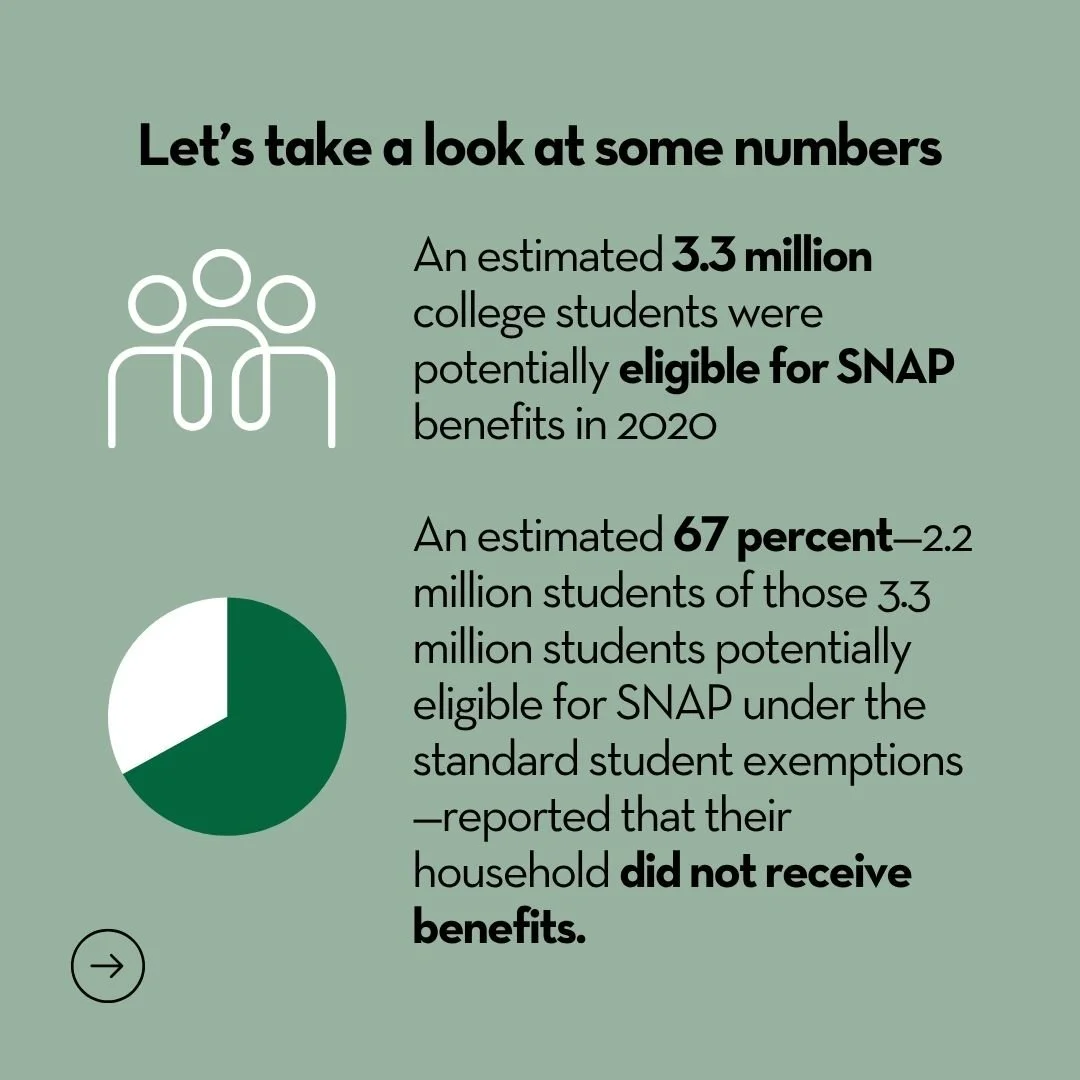
College hunger is a growing problem in the U.S with roughly 40% of students reporting food insecurity. However, recent studies from the US Government Accountability Office to Congress show that more than half of all potentially eligible college students are not participating in SNAP.
SNAP (The Supplemental Nutrition Assistance Program) is the United States frontline program targeting food insecurity. It is an entitlement program – which just means there is never a waiting list: if someone is eligible, they will receive the benefit. However, there are additional rules related to college student eligibility. In addition to the income, and citizenship/immigration status rules, students must also meet student eligibility rules.
Students need to consider the following to determine if they are eligible:
-
If you are under age 22 and live at home with your parents while attending school, you are not able to apply for SNAP separately from your parents. This rule is from the general eligibility requirement for who must be in the same SNAP household.
If you meet the student eligibility requirements (as described below), and you are under 22 and living with your parents, you would need to apply with them (and any younger siblings) as one household unit.
If you are under 22 and you live with other family relatives such as a grandparent, uncle/aunt, or older sibling, you are not subject to the age restriction and may be able to apply on your own.
If you have roommates and you buy and share food together, you must apply together in the same SNAP household. If you keep your food separate, you can apply separately.
If you do not meet the student eligibility requirements (as described below), you would be excluded from receiving any SNAP as a member of your household. Additionally, any income you earn or receive would also be excluded from the total household income.
-
Students who have a meal plan that covers more than half (11 or more meals per week) of their weekly meals are not eligible for SNAP under any circumstances, even if you are meeting any of the eligibility provisions below. (This is based on a rule that says that anyone who lives at an institution that provides more than half of their meals is ineligible for SNAP).
-
Students who are enrolled “half-time or more” at “an institution of higher learning” must satisfy additional student rules. Here are are two key phrases here to consider:
“Half time or more” – Each school defines half-time differently, but usually it’s about 6 credits. If you are enrolled “less than half time” the rules below do not apply to you.
“An institution of higher learning” – If your school or training program does not require a GED or high school diploma, the extra rules below also don’t apply to you.
If you are enrolled at least half-time in a program that requires a high school diploma or GED, you should know that the government still considers you a student while you are on break in between semesters and school years. For example, federal SNAP rules consider someone an enrolled student during summer vacation if they graduate in June and intend to start graduate school in the fall.
-
If you are considered a student based on your status above, you must either meet the work requirement or have another qualifying situation.
-
Federal rules require college students to also have paid employment to qualify for SNAP. The work requirement can be met by meeting any of the following:
Work 20 hours a week. This includes hours worked in exchange for tuition reduction. If you are self-employed (e.g. Uber/Lyft/TaskRabbit) you will also need to show your work hours – or;
Have a work-study award and work any number of hours or expect to take a work-study position – or;
Participate in an on-the-job training program that is not an unpaid internship, such as a nursing practicum or something along those lines.
-
If you do not meet the student work rule above you can still be eligible for SNAP if these situations apply to you:
You care for a child:
a single parent enrolled full-time and have children younger than 12;
a parent in a two-parent household with children under age 6, or if you have children age 6 through 11 and cannot find child care for both school and work;
You are under age 18 or age 50 or older
You have a physical or mental health condition that restricts your ability to work in addition to attending school. If you don’t receive a disability benefit, have this medical exemption form completed by your provider or school’s office of accommodations to verify your condition.
You attend Community College in a field of study that is supported by federal training funds and/or is in high demand. The majority of courses of study at community colleges meet these requirements. A school administrator will be able to confirm if either of these are the case and should fill out one of these forms for you to send in with your SNAP documents.
You participate in an approved program aimed at improving employability:
Act 101 program at your school
Former Foster Care Tuition Waiver
TRIO Student Support Services at University of Pittsburgh and PennWest
TRIO McNair Scholars Program at University of Pittsburgh
Kessler Scholars program at University of Pittsburgh
TANF/ cash assistance
WIOA program (Career Links)
KEYS
PA DHS may add more programs to this list as they are identified. See Enrolled in Compliance With Programs That Increase Employability (these programs have to have certain state or federal funding to qualify them).
You participated in an approved program prior to college that was geared toward improving your employability:
TRIO Upward Bound
Gaining Early Awareness and Readiness for Undergraduate Programs (GEARUP)
Education Leading to Employment and Career Training (ELECT)
Title II Adult Basic Education
Chafee Education and Training Grant
PA DHS may add more programs to this list as they are identified. See Enrolled Through Programs That Increase Employability.
Need help with food stamps in Allegheny County, PA?
We can provide a 5-minute SNAP eligibility screening, complete your SNAP application, or help you with any problems you’re having receiving SNAP!